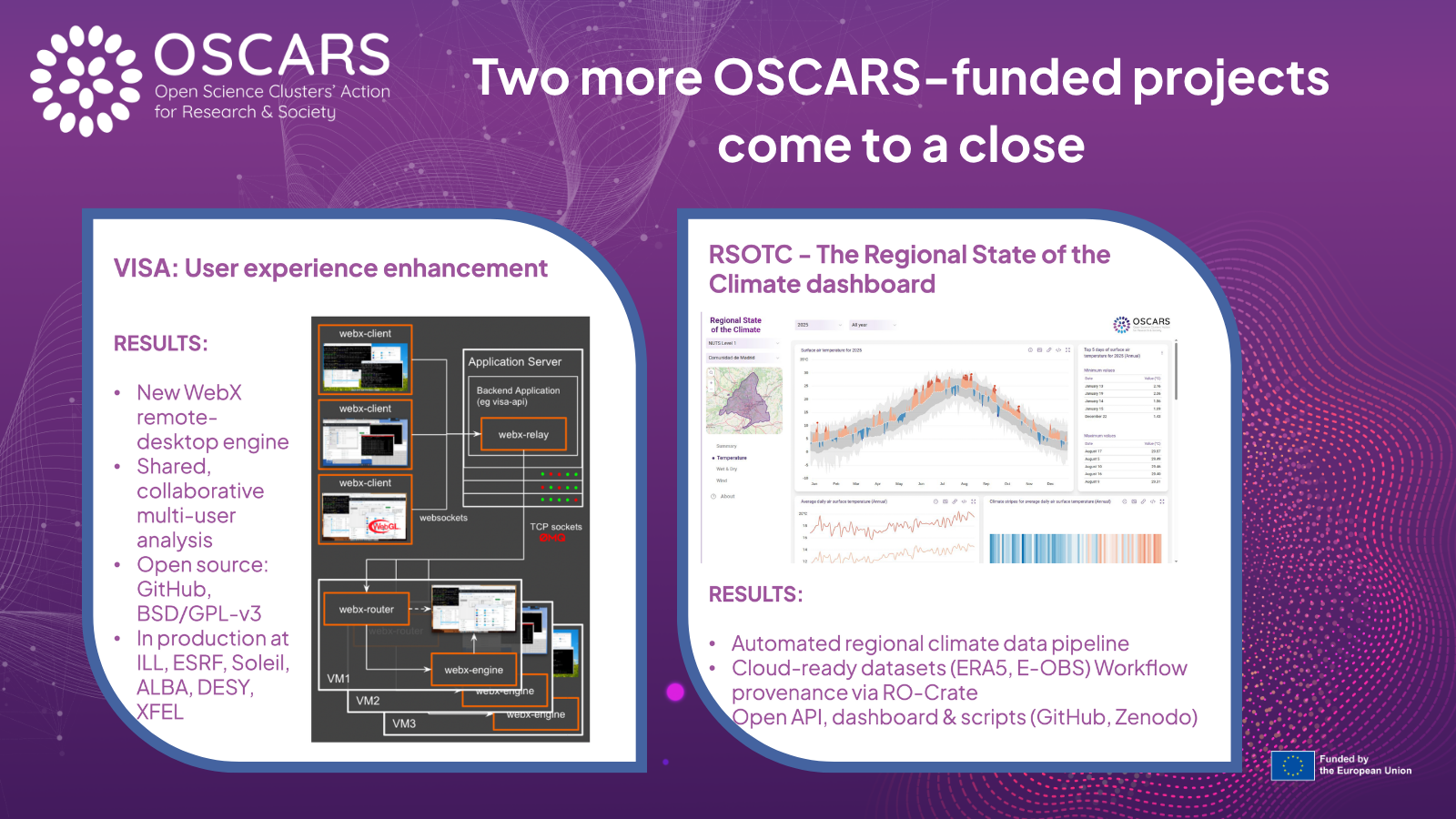
Two projects funded through the 1st OSCARS Open Call - VISA - User Experience Enhancement, and RSOTC - The Regional State of the Climate dashboard - have now completed their work, adding to the growing portfolio of finished OSCARS results. Both launched on 1 October 2024. VISA ran for 20 months and RSOTC for 18 months.
The two projects tackle very different problems. VISA improves how researchers access and analyse experimental data remotely, streamlining an existing virtual research environment used across major European large-scale facilities. RSOTC builds a new service from scratch, turning fragmented global climate reporting into a FAIR-by-design regional dashboard. What they share is a commitment to making research infrastructure and research data genuinely (re-)usable - one by removing friction from an existing research tool, the other by opening up a category of data that previously lacked regional detail and reproducibility.
VISA: collaborative remote access to scientific data
Science Cluster: PaNOSC - Photon and Neutron Science
VISA — the Virtual Infrastructure for Scientific Analysis — gives researchers remote access to data, hardware resources, and preinstalled, ready-to-use scientific software, without the need to move data or configure local environments. Developed and operated by the Institut Laue-Langevin (ILL) in Grenoble, VISA is already in production and used well beyond ILL itself: at ESRF, Soleil, ALBA, DESY, and the European XFEL.
The OSCARS-funded phase of the project, led by Ludovic Leroux, addressed a specific limitation: the remote-desktop technology underlying VISA (Guacamole) suffered from input lag, graphical artefacts, imprecise interaction, and heavy CPU use on the remote machine. The team's response was to build WebX, a new window-based remote desktop engine, from the ground up. WebX captures X11 windows and their content directly, transmits them efficiently over ZeroMQ with low CPU and bandwidth overhead, and streams updates to the browser using libjpeg-turbo compression with partial updates.
Beyond performance, the project added features that let multiple users share the same VISA instance and collaboratively analyse the same experimental dataset together - a direct improvement, the team notes, to how research groups can work together on shared data.
All of this is openly available: the complete code repository is published on GitHub, documentation is maintained on Read the Docs, and the software is dual-licensed under BSD and GPL-v3.
- Code: https://github.com/ILLGrenoble/
- Documentation: https://visa.readthedocs.io
- Poster (Zenodo): DOI https://10.5281/zenodo.18775365
RSOTC: a FAIR-by-design dashboard for regional climate data
Science Cluster: Environmental Research Infrastructures – ENVRI
Global and continental State of the Climate reports - from theWorld Meteorological Organization - WMO, Copernicus Climate Change Service, Agencia Estatal de Meteorología - AEMET, National Oceanic and Atmosferic Administration - NOAA, and others - have become an increasingly relied-upon public resource. But they share three consistent gaps: they rarely offer detail at the scale of European political regions (NUTS divisions), the code and pipelines behind them are usually closed and non-reproducible, and they tend to omit the statistical detail - trends, extremes, long- versus short-term variability - that turns raw climate data into decision-useful insight.
The Regional State of the Climate (RSOTC) project, led by Daniel San Martín Segura at Predictia (Spain), with IFCA-CSIC as a subcontracted partner, set out to close that gap with a FAIR-by-design web dashboard for European regional climate monitoring. Over the course of the project the team built:
- A scalable climate data downloading system, automating retrieval of historical climate variables from trusted sources such as the Copernicus Climate Data Store.
- A standardised processing pipeline that cleans metadata, aligns naming conventions, and harmonises variables across datasets.
- Cloud-ready, regionally aggregated datasets, transforming gridded climate data (ERA5 reanalysis, E-OBS) into region-specific time series suited to interactive platforms and large-scale analytics.
- Automatic provenance recording of every computational workflow run, using the RO-Crate (Research Object Crate) standard — giving each result a transparent, traceable history.
The resulting service — an API, a web interface, and a set of open scripts — is designed for integration into ENVRI's service catalogue, and all outputs are published under open licences on GitHub and Zenodo. The team presented the project's approach at the EOSC-ES Tripartite Event in September 2024 and at the European Meteorological Society's Annual Meeting in Ljubljana in September 2025.
Looking beyond the project's end, the team's stated sustainability plan is to migrate the deployed services fully onto EOSC infrastructure, and to offer consulting on new climate indices as a way of funding ongoing maintenance.
- Poster (Zenodo): DOI https://10.5281/zenodo.18803516
Two different problems, one Open Science outcome
VISA and RSOTC show two different faces of what the OSCARS cascading grant mechanism supports: strengthening infrastructure already in operational use, and building entirely new FAIR-by-design services where none existed before. In both cases, the result is the same: software and tools that are more open, better documented, and more reusable than what came before.
Further details on each project can be found on the OSCARS website: https://oscars-project.eu/projects