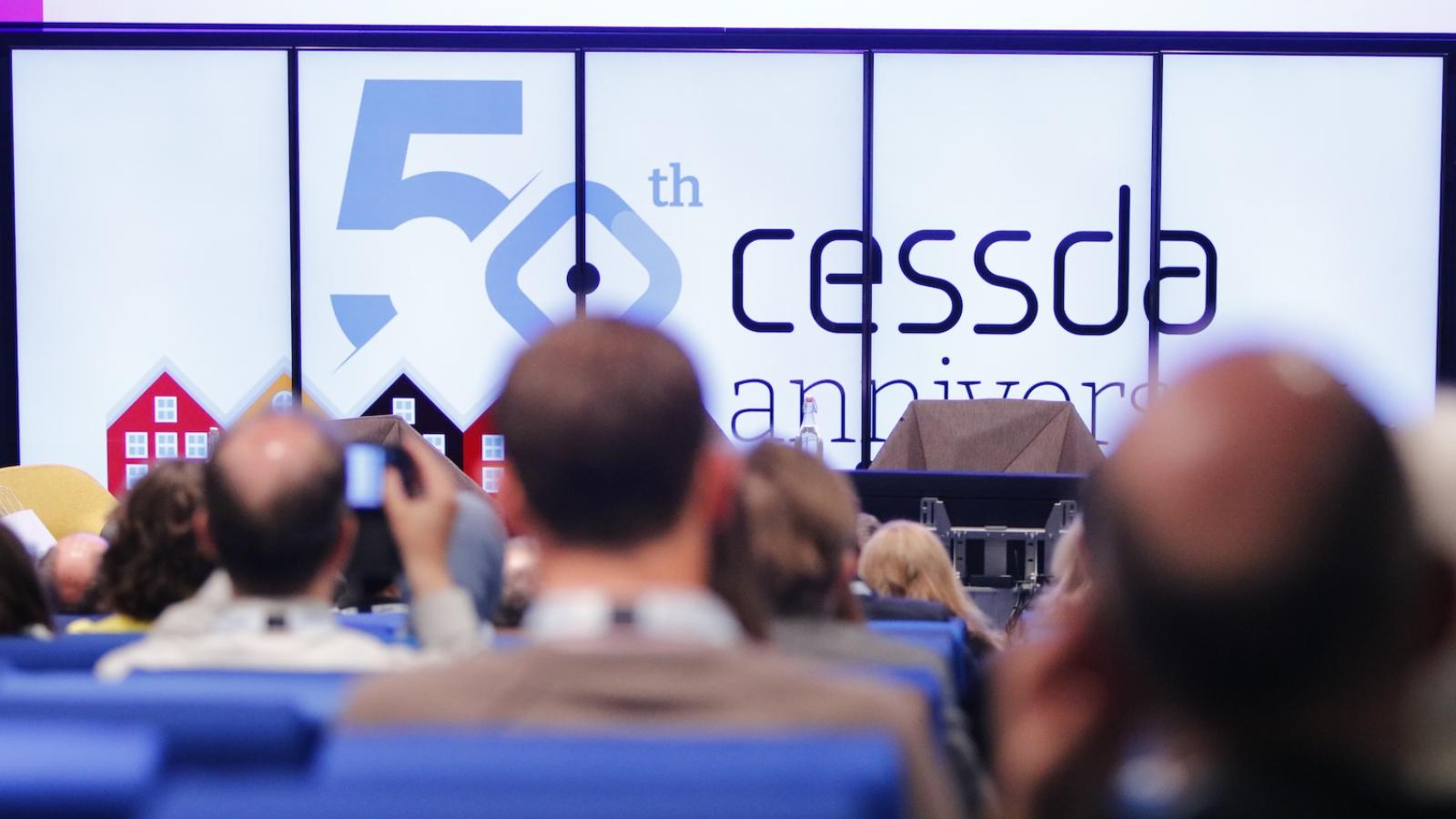
From a vision first proposed in 1955, through a partnership between a small group of European data archives, to a European research infrastructure with connections around the world, CESSDA recently celebrated its 50th anniversary with a four-day conference in Bergen, Norway.
CESSDA, the Consortium of European Social Science Data Archives, supports researchers by making high-quality social science data easier to discover, access and reuse. Its anniversary conference brought together members of the European and international social science data community, alongside research infrastructure leaders, policymakers and representatives from other scientific disciplines.
The first two days were dedicated to internal workshops and discussions on the future of CESSDA and its Working Groups. Sessions covering interoperability, Dataverse, artificial intelligence and other key topics gave participants the opportunity to exchange knowledge and help shape CESSDA’s future development.
The public programme began with a reception hosted by the City of Bergen in the historic Håkonshallen, once part of the medieval royal residence. Following speeches by Bergen’s Deputy Mayor and CESSDA Executive Director, Bonnie Wolff-Boenisch, and a performance by a local male choir, the open conference was officially under way.
The following two days took place at Media City Bergen, a hub for media, technology and research organisations. The programme opened with a session chaired by Bonnie Wolff-Boenisch, in which past and present CESSDA leaders reflected on the organisation’s development and its future direction.
Each day was organised around CESSDA’s three strategic themes: Landscape, Data and People. The first Landscape session brought together Sally Chambers, Director of DARIAH; Eija Juurola, Executive Director of ACTRIS ERIC; EOSC Director Klaus Tochtermann; Bonnie Wolff-Boenisch; and European Commission representative Michael Arentoft as discussant. Chaired by José Luis Martínez Peña of the ESFRI Forum, the session examined how the European Research Area can support stronger cross-border and interdisciplinary collaboration.
The first day also featured Darja Fišer, Executive Director of CLARIN ERIC; Tiziana Ferrari of the EGI Foundation; Simon Hodson of CODATA; and Professor Erik Øiolf Sørensen of the Norwegian School of Economics, alongside speakers from across CESSDA’s network of Service Providers. The day concluded with a keynote by Linda Nøstbakken of Statistics Norway. Drawing on the Norwegian experience, she explored how sustained investment in data documentation, standardisation and accessibility has expanded opportunities for research and policymaking, while digitalisation raises new questions about privacy, trust and social licence.
Richard Welpton of UK Research and Innovation opened the final day, which further highlighted the international reach of the conference. In total, more than 25 countries from five different continents were represented on stage.
The Landscape session included Brett M. Powell of the Roper Center in the United States, Matthew Gray of the Australian National University and Carthage Smith of the OECD. The Data session featured Marta Curto-Grau from the Barcelona Supercomputing Center and Pei-shan Liao from Academia Sinica in Taiwan.
The final People session brought together Seokho Kim of Seoul National University in South Korea; Yasuyuki Minamiyama of the University of Tokyo in Japan; Javier Terán of the United Nations Office for the Coordination of Humanitarian Affairs; Lynn Woolfrey of DataFirst at the University of Cape Town in South Africa; and Jeannette Jackson of the University of Michigan in the United States.
The conference’s final keynote was delivered by Barbara Wasson from the University of Bergen. She considered how social science data and research infrastructures must evolve to remain foundations for trust and innovation in an age increasingly shaped by artificial intelligence.
In the closing session, Vigdis Namtvedt Kvalheim, Vice-Chair of the CESSDA General Assembly, reflected on CESSDA’s development over the past 50 years. Bonnie Wolff-Boenisch thanked the participants, speakers, chairs, rapporteurs and organisers, as well as everyone who contributed on stage and behind the scenes.
Artificial intelligence was a recurring theme throughout both the internal and public programmes. Participants discussed regulation, ethics, risks, good practice and new possibilities for data collection, analysis, preservation and access. As AI becomes increasingly influential across the research data lifecycle, CESSDA will continue to adapt while promoting trustworthy, responsible and accessible social science data.