Science cluster & challenges


Summary
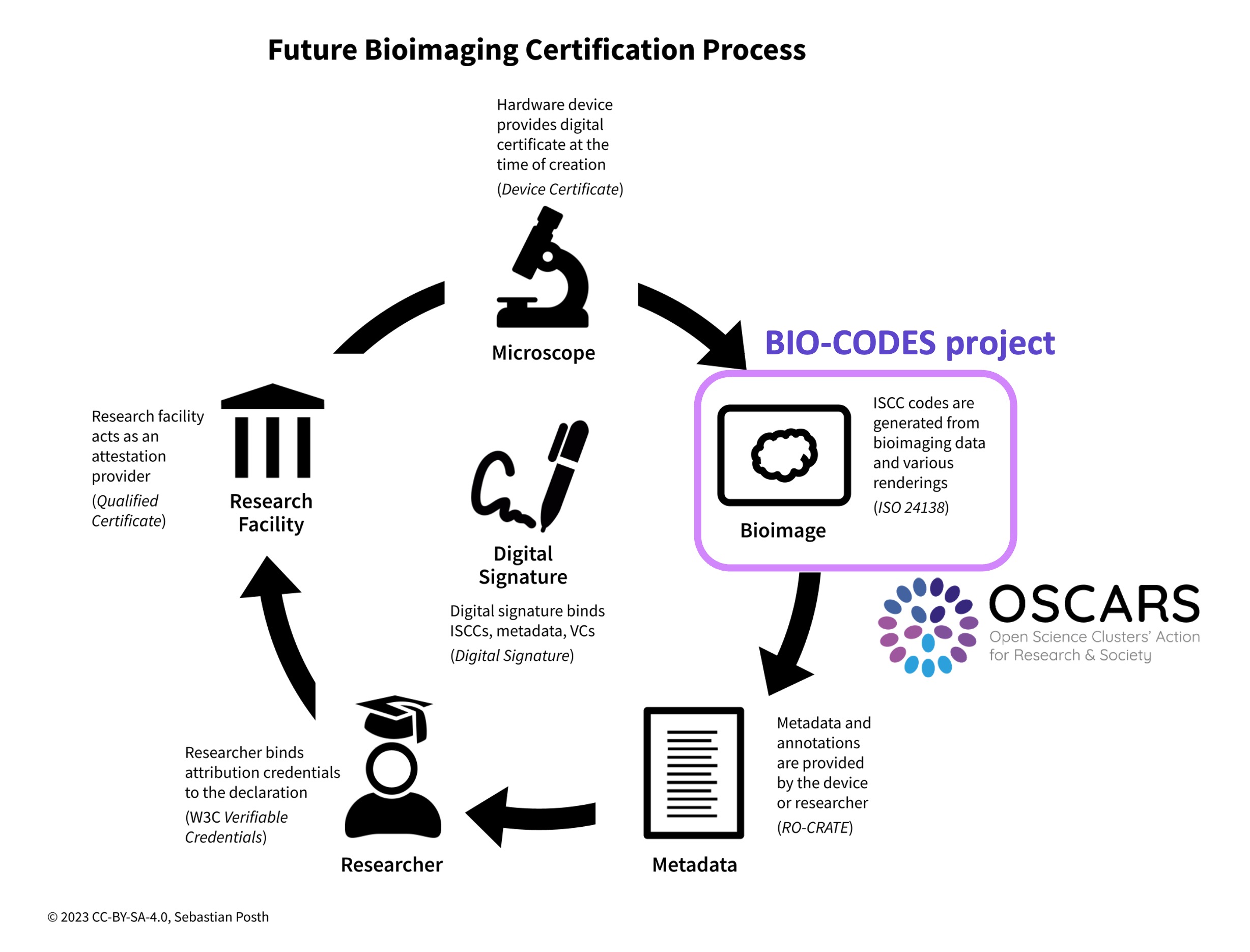
(Standardised) content identification is becoming an essential requirement for bioimaging data reuse and the seamless integration of bioimaging data into AI models. Transparency regarding the origin of data, distinguishing between conventionally generated and AI-generated data, is essential to maintain data integrity and facilitate informed analysis. In this context, the International Standard Content Code - ISCC is a new, open-source identification system and global ISO standard, ensuring transparency, accessibility, and widespread adoption. The BIO-CODES project seeks to enhance the AI-readiness of bioimaging data by developing and implementing content-based identifiers, using ISCC. The project addresses the increasing complexity of bioimaging data, ensuring it adheres to FAIR principles, and prepares datasets for reliable use in AI-driven analyses. By integrating globally unique references into key platforms, such as OMERO, BIO-CODES aims to advance data integrity and streamline bioimage certification processes, ensuring transparency and reproducibility.
Challenge
Open Science project, Industry cooperation, Main RI concerned, Cross-domain/Cross-RI
As bioimaging data grows in complexity, much of it remains non-compliant with FAIR principles, which complicates data reuse and AI integration. Current methods for identification and certification of bioimaging data lack the robustness needed for generative AI models, risking data integrity, data reliability, thus scientific reproducibility. Addressing these gaps is essential to ensure bioimaging data’s value in Life Sciences research and mitigating biases in AI-driven analyses.
Solution
BIO-CODES will evaluate the ISO 24138 International Standard Content Code (ISCC) and apply it to bioimaging data in Life Science research. Generated from digital content using cryptographic and similarity hash algorithms, ISCC ensures data integrity and supports use cases like deduplication, database synchronisation, and data provenance. The project will test routine proprietary formats from imaging core facilities and engage vendors. If ISCC proves useful, recommendations will be made for integrating it into existing workflows and software applications used for authentication and certification of bioimages. The main goal is to assess ISCC's applicability and create a proof-of-concept, with integration into platforms like OMERO to ensure FAIR compliance.
*OMERO is one of the most versatile and widely used platforms for managing bioimaging data, offering tools for storage, organisation, and analysis. By seamlessly integrating globally unique identifiers into OMERO it will streamline AI-driven bioimaging data preparation while ensuring data integrity and FAIR compliance. Standardised authentication processes will enable researchers to share datasets confidently, enhancing transparency and reproducibility. This approach also addresses ethical concerns in AI, mitigating biases from unverified data and promoting reliable AI models in biomedical research.
Scientific Impact
BIO-CODES will enhance transparency and collaboration among researchers by introducing standardised content identifiers in bioimaging workflows. This enhances data reuse, mitigates ethical concerns in AI applications, and improves the reliability of AI models in Life Sciences. The ISCC’s ability to generate unique identifiers directly from digital files ensures ease of use and eliminates the need for manual management like DOIs. Its open-source nature supports decentralised digital content identification and encourages continuous improvement through collaboration among researchers, developers, and institutions.
Results
- High-Performance ISCC Implementation for Bioimaging Data: Developed and released iscc-sum, a Rust-based tool that generates ISCC Data-Code and Instance-Code hashes 50-130x faster than reference implementations, processing data at 950-1050 MB/s. The tool addresses performance bottlenecks in large-scale bioimaging data identification.
- ISO 24138:2024 Standard Compliance and Extension: Implemented two units of the International Standard Content Code (ISCC) with full ISO 24138:2024 compliance via narrow format, plus an extended wide format for enhanced security and similarity matching capabilities in bioimaging applications.
- Cross-Platform Research Software Package: Released open-source software with Python API and command-line interface supporting Linux, macOS, and Windows. The package includes a comprehensive test suite (100% coverage), type annotations, and is distributed via PyPI for easy installation.
- Data-Based Similarity Detection System: Implemented data-defined chunking algorithms that enable identification of similar or duplicate bioimaging files based on actual content rather than filenames. This supports data deduplication and quality control in AI training datasets.
- Multi-Source Data Processing Capabilities: Integrated fsspec support, enabling direct processing of bioimaging data from cloud storage (S3), HTTP/HTTPS sources, and local filesystems through a unified interface, facilitating distributed research workflows.
- BIOCODES project is now community partner on Image.sc
Publications
- ISCC-SUM: High-Performance ISCC Generation for Bioimaging Data, DOI: https://doi.org/10.5281/zenodo.16541263
- BIO-CODES: Enhancing AI-Readiness of Bioimaging Data with Content-Based Identifiers - project poster 2nd OSCARS AGM 2026, DOI: https://doi.org/10.5281/zenodo.18914995
Events
- 03-06 June, 2025 | Heidelberg, Germany - Poster entitled BIO-CODES presented at the ELMI meeting, 25th international meeting of the European Light Microscopy Initiative | Presentation
- 17-18 June, 2025 | Utrecht, the Netherlands - Innovative Imaging for 3D Cell Biology conference | Presentation
- 1-3 October 2025 | Freiburg im Breisgau - Galaxy Europe, European Galaxy Days - Presentation of the progress of the BIO-CODES project to the Galaxy community
- 30 September 2025 | NL BioImaging Presentation - Presentation of the progress of the BIO-CODES project to the NL BioImaging community
- 20-21 November 2025 | Berlin, Germany - CytoData 2025 - BIO-CODES Poster presentation to the image-based profiling and bioimage analysis community
- 25-27 March 2026 | Vienna (TU Wien), Austria - FDO Conference 2026 - Presentation of the progress of the biocodes project to the FDO (FAIR Digital Objects) community
- 13-17 April 2026 | Online - Euro-BioImaging: Image Data Community Days - Presentation of the progress of the BIO-CODES project to the Euro-BioImaging community
Communication Material
- Presentation BY Titusz Pan: "BIO-CODES. Enhancing AI-Readiness of Bioimaging Data", Catch-Up Meeting - iscc-sum, 28 March, 2025
- Presentation BY Titusz Pan: "BIO-CODES. Enhancing AI-Readiness of Bioimaging Data", Catch-Up Meeting - iscc-sum, 21 July, 2025
Engagement activities planned
- BIOCODES community partner on Image.sc: Communicate broadly about the BIO-CODES initiative through the dedicated Image.sc community channel - https://forum.image.sc/tag/biocodes/2973. Share project updates, software releases, use cases, tutorials, and engage with the wider bioimaging community to encourage adoption and feedback.
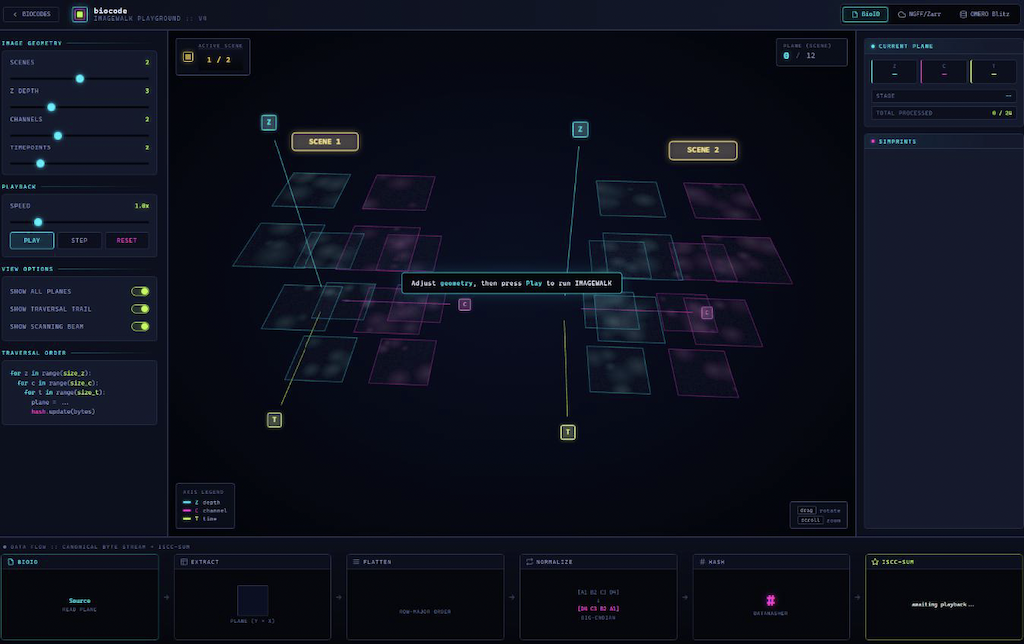
- BIOCODES and Euro-BioImaging infrastructure: Introduce BIO-CODES to the Euro-BioImaging community through webinars, community meetings, facility manager networks, and scientific events. Present how ISCC-SUM and IMAGEWALK can support FAIR and AI-ready bioimaging data, data provenance, integrity verification, and duplicate detection for imaging facilities and users.
- BIOCODES and QUAREP-LiMi: Engage with QUAREP-LiMi (Quality Assessment and Reproducibility for Instruments & Images in Light Microscopy) to explore integration of content-derived identifiers into microscopy quality assurance and reproducibility workflows. ISCC-SUM and IMAGEWALK can support traceability of reference datasets, verification of image integrity, provenance tracking, and FAIR data practices. Potential activities include presentations within relevant QUAREP-LiMi working groups, collaborative case studies, and exploration of ISCC integration into community guidelines and metadata recommendations.
- BIOCODES and the OME community: Through the GerBI-GMB collaborator Josh Moore and existing links with the OME ecosystem, communicate project results to the OME, OMERO, and OME-Zarr communities. Promote the OMERO plugin prototype, discuss future implementation of ISCC identifiers in OME-XML and OME-Zarr metadata, and gather community feedback for broader adoption.
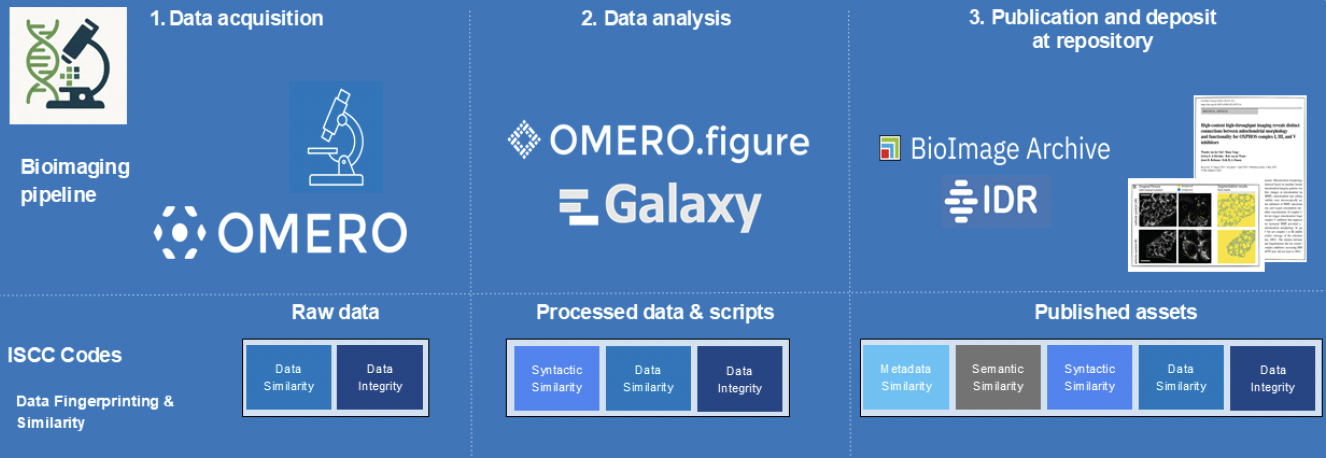
- BIOCODES and the imaging public repositories (IDR and BIA): Engage with the Image Data Resource (IDR) and BioImage Archive (BIA) teams to evaluate the use of ISCC-SUM and IMAGEWALK for dataset integrity verification, duplicate detection, provenance tracking, and AI-training dataset management. Explore pilot studies demonstrating repository-scale content identification and similarity search capabilities.
- BIOCODES implementation at the source: discussions have been initiated with Nikon Europe BV, which expressed interest in integrating BIO-CODES content identifier generation directly into proprietary imaging software. Future efforts will extend discussions to additional microscope manufacturers through the Euro-BioImaging Industry Board, with the goal of generating ISCC identifiers at the point of image acquisition and embedding them into the imaging workflow from the outset.
- BIOCODES and Galaxy: Promote the already available Galaxy tools for ISCC generation, content verification, and near-duplicate detection through the Galaxy and BMCV communities. Organise demonstrations and tutorials highlighting how content identification can be integrated into reproducible image analysis workflows.
- BIOCODES metadata standardisation: Continue discussions with developers of OME-XML, RO-Crate, REMBI, and related metadata initiatives to investigate formal inclusion of ISCC identifiers as persistent content verification and provenance elements within existing metadata standards.
- BIOCODES and AI-ready bioimaging datasets: Engage with AI, machine-learning, and bioimage analysis communities to demonstrate how content-derived identifiers can improve training dataset traceability, benchmark reproducibility, dataset de-duplication, and provenance management for trustworthy AI applications in life sciences.
Principal investigator

Dr. Sylvia le Dévédec is an assistant professor and researcher specializing in cell biology, bioimaging, and cancer research. With a PhD in the field of life sciences, she has developed extensive expertise in high-content bioimaging and advanced data analysis, focusing on the integration of cutting-edge technologies in biomedical research. Sylvia's work emphasizes data integrity and reproducibility, which aligns with her leadership of the BIO-CODES project, where she aims to enhance the AI-readiness of bioimaging data. Her research contributes to Open Science initiatives, fostering collaboration across academia and industry. Through BIO-CODES, she is pioneering efforts to standardise bioimaging data, ensuring transparency, FAIR compliance, and the ethical application of AI in life sciences.