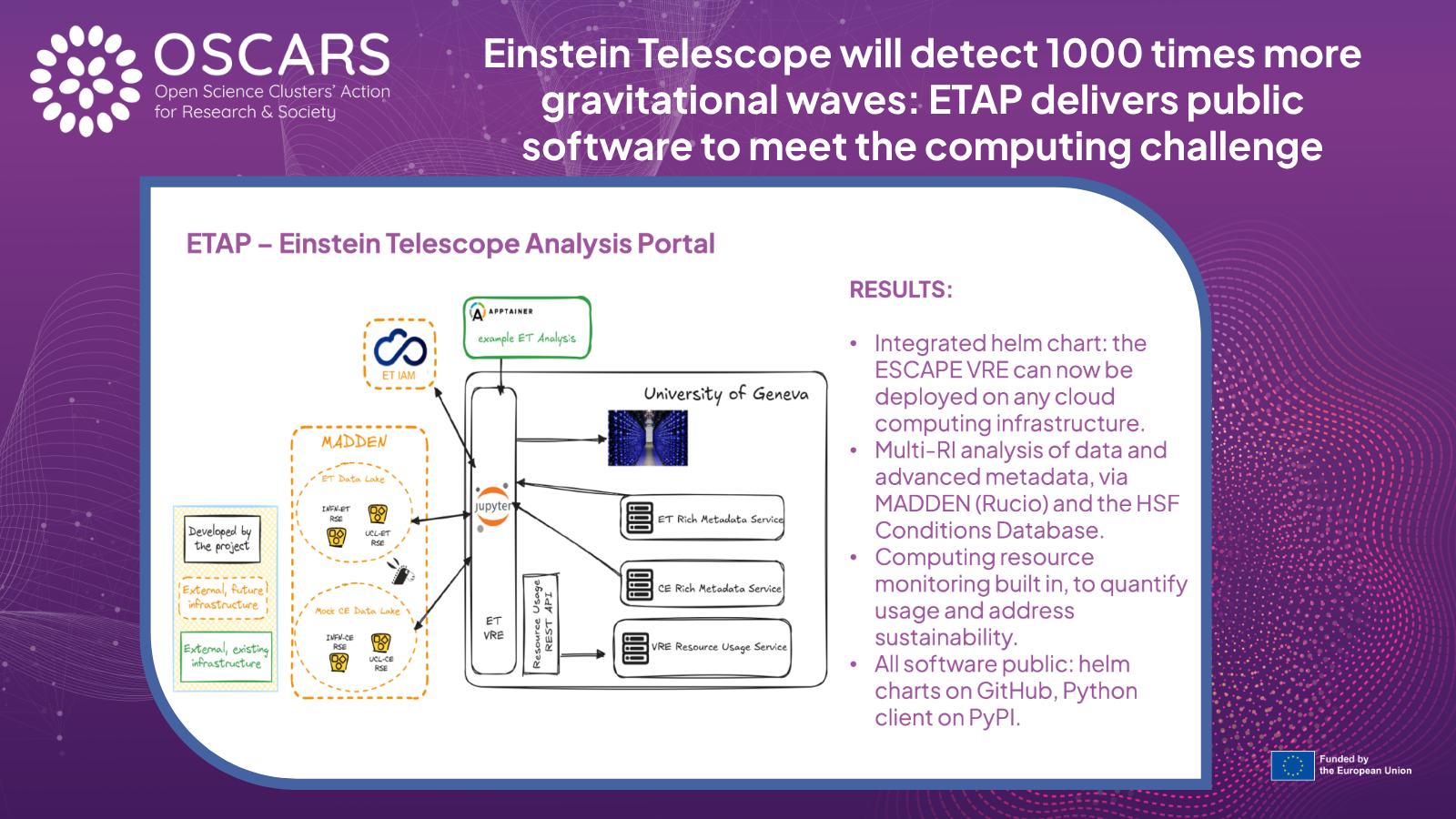
The first direct observation of gravitational waves (GWs) in 2015, produced by the collision of black holes, seeded a demand for open access to GW data that has grown ever since. The Einstein Telescope (ET), the next generation European GW detector, will increase the detection rate of GWs by a factor of a thousand compared to current detectors, producing information-rich data containing a wealth of astrophysical signals. This surge in information density, combined with the need for cross-disciplinary collaboration in multi-messenger astronomy, presents significant computational and metadata challenges: analysing 1000 times more GW signals, analysing data and advanced metadata from multiple Research Infrastructures (RIs), and estimating computing resources for ET and Open Science, to address sustainability concerns.
The OSCARS-funded project ETAP – Einstein Telescope Analysis Portal, led by Paul Laycock at the University of Geneva, with Volodymyr Savchenko, Hubert Degaudenzi, ran for 18 months to address these challenges. ETAP is a Virtual Research Environment (VRE) for the Einstein Telescope. It will help assess ET's computing needs and, at the same time, provide a powerful tool for Open Science.
The ESCAPE Virtual Research Environment, initially developed and deployed at CERN, was taken as the foundation of the solution. The ETAP team:
- Repackaged it as an integrated helm chart (a ready-made package for installing software on cloud infrastructure), so that it can be deployed on any cloud infrastructure.
- Extended its functionality to handle data from multiple RIs, thanks to the sister project MADDEN, which uses Rucio for scientific data management.
- Handled advanced metadata with the HEP Software Foundation (HSF) Conditions Database (HSF CDB), with a new Python client package developed in the project to provide multi-RI functionality.
- Added industry-standard computing monitoring packages to the newly repackaged ESCAPE VRE, to quantify resource usage and address sustainability concerns.
The main output of ETAP is the integrated helm chart that allows the ESCAPE VRE to be deployed on any cloud computing infrastructure, together with the corresponding HSF CDB helm chart and the multi-RI Python client. All are public, and all are contributions to the broader ESCAPE VRE ecosystem. The vision guiding the project was an integrated helm chart allowing flexible configuration of ESCAPE VRE components, so that different communities can target deployments to their needs.
The ESCAPE VRE serves the whole community and can now be deployed anywhere that has cloud computing infrastructure. The HSF CDB follows best-practice guidelines developed by the HSF and is being explored by a growing number of scientific communities. The software packages were made in collaboration with colleagues from ET, CERN and the HSF. ET will start taking data in the early 2040s and run for 50 years, so sustainable solutions are a must. The team also contributed to the ACAT 2025 and CHEP 2026 conferences, with proceedings in preparation.
- ESCAPE VRE helm charts: github.com/vre-hub/helm-charts
- HSF CDB helm chart: github.com/paullaycock/nopayloaddb-charts
- Multi-RI Python client: pypi.org/project/nopayloaddb-client
- Final poster: DOI 10.5281/zenodo.21669446
- Project webpage: oscars-project.eu/projects/etap-einstein-telescope-analysis-portal