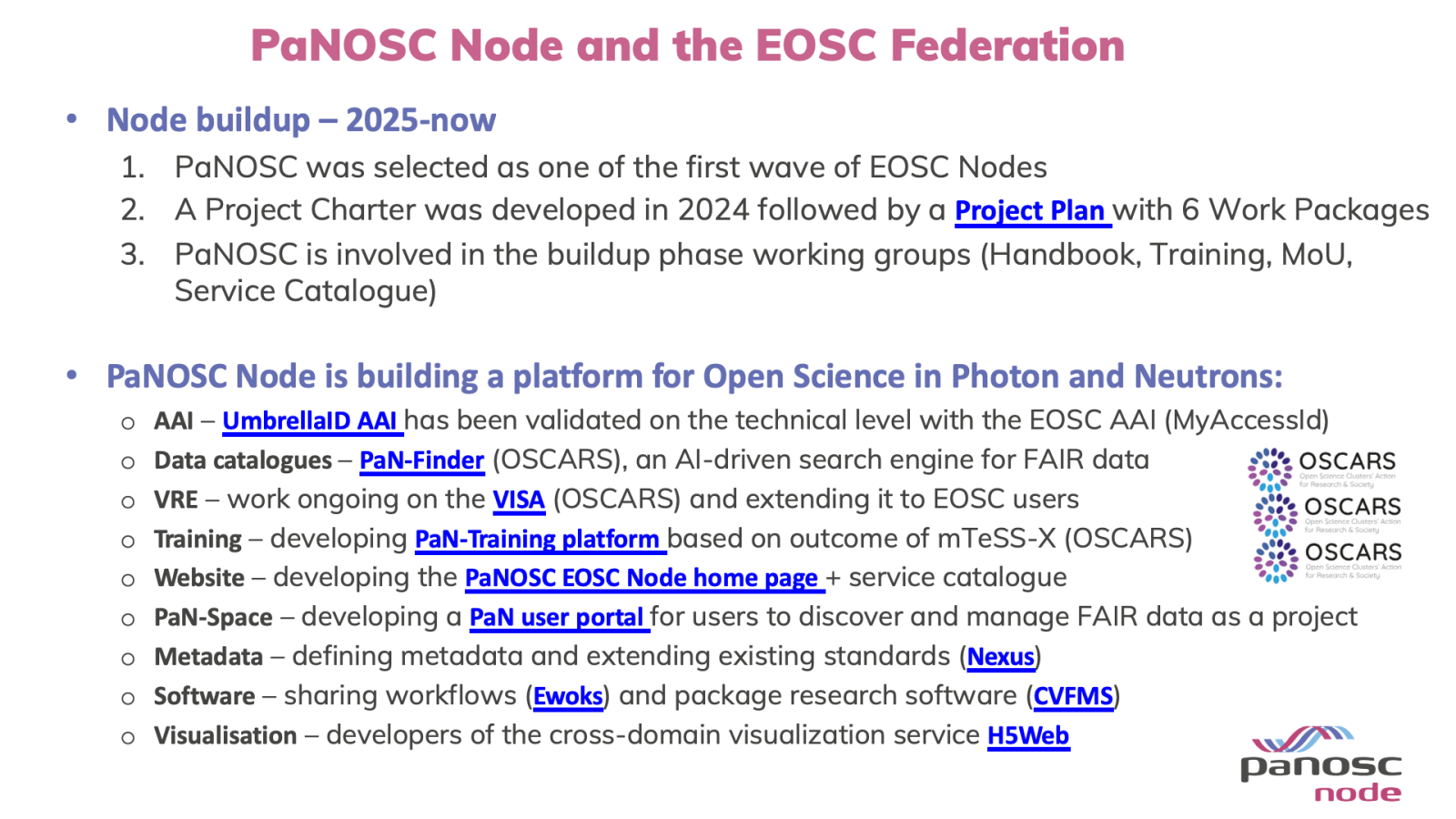
At the OSCARS and EOSC Association webinar on “EOSC Federation and the Science Cluster EOSC Nodes & Hubs: Onboarding of Services”, held on 17 February 2026, Andy Götz, coordinator of the PaNOSC EU Node and member of the EOSC Association, presented the PaNOSC node and its role within the EOSC Federation.
In 2025, the Photon and Neutron Open Science Cloud (PaNOSC) node was selected as one of the first-wave EOSC Federation nodes. As part of this process, PaNOSC developed a project charter and implementation plan and has been actively contributing to the EOSC build-up phase, including participation in working groups on the Federation Handbook, training, service catalogues and the definition Memorandum of Understanding.
PaNOSC positions itself as a provider and enabler of scientific services. It is a platform providing data, software and compute infrastructure for services to operate within EOSC. Through the PaNOSC platform, users benefit from a single point of entry to data and services offered across currently 11 partner facilities (with additional partners joining soon), including AI-driven data discovery tools, access to open (meta)data, and a user workspace to manage datasets and service requests.
Among the core components are several services consolidated from earlier projects (2018–2022) and extended through OSCARS-related initiatives. These include:
- VISA (Virtual Infrastructure for Scientific Analysis) is based on the VISA technology developed at ILL, which underpins the PaNOSC Virtual Research Environment. VISA goes beyond running Jupyter notebooks by enabling graphical applications and full desktop environments, allowing advanced data visualisation and analysis within a browser-based interface.
- PaN-Finder, an AI-driven data discovery tool that searches across metadata from open datasets at photon and neutron facilities and uses generative AI to provide contextual information about experiments and results.
- The PaN training platform, which supports skills development and community building for Open Science in PaN research.
The platform also introduces a growing class of users: researchers requesting access to digital resources and existing datasets without applying for beamtime at analytical facilities. Through federated access and shared infrastructure, PaNOSC aims to accelerate thedata-driven use of photon and neutron research outputs.
Currently hosting 19 registered services, the PaNOSC node welcomes additional services that meet its evolving onboarding requirements: thematic relevance, implementation of Open Science principles, operational maturity (TRL7), compliance with EOSC AAI, implementing EOSC Federating Capabilities, agreement with GDPR and EOSC Federation policies, and clear ownership and sustainability arrangements.
Services may either remain hosted by their original providers and be registered in the PaNOSC service catalogue, or be hosted and deployed directly on PaNOSC infrastructure at participating facilities, ensuring it is compatible with PaNOSC tools.
Through its expertise and competence centres, the PaNOSC community offers support for onboarding and integration. In doing so, the Node is building a federated platform for Open Science in PaN research, providing a structured pathway for sustainable service onboarding to the EOSC ecosystem.
If your project develops services in the domain of PaN science, get in touch with the PaNOSC Competence Centre to identify the steps to onboard them to the PaNOSC Node.